



FedRAMP 20x: What It Is and Where It Stands Today
Last updated: March 27, 2026
Traditional FedRAMP pathways have long been criticized for being slow, manual, and documentation heavy. Even if you had the time, money, and effort to go through the authorization process, the larger question always loomed: “Can I find a Federal Agency “Sponsor” to partner with me through the Authority to Operate (ATO) process?”
Enter FedRAMP 20x — a new assessment and authorization path being developed in collaboration with industry and government. Its main goal? Rapidly increase the size of the FedRAMP Marketplace for agencies to be able to use the best Cloud Service Offerings (CSOs) commercially available, while maintaining protection over unclassified information.
In this post, we’ll explain what FedRAMP 20x is, how it differs from the existing Rev. 5 model, and where the program stands today — including the official phase structure and timelines.
What Is FedRAMP 20x?
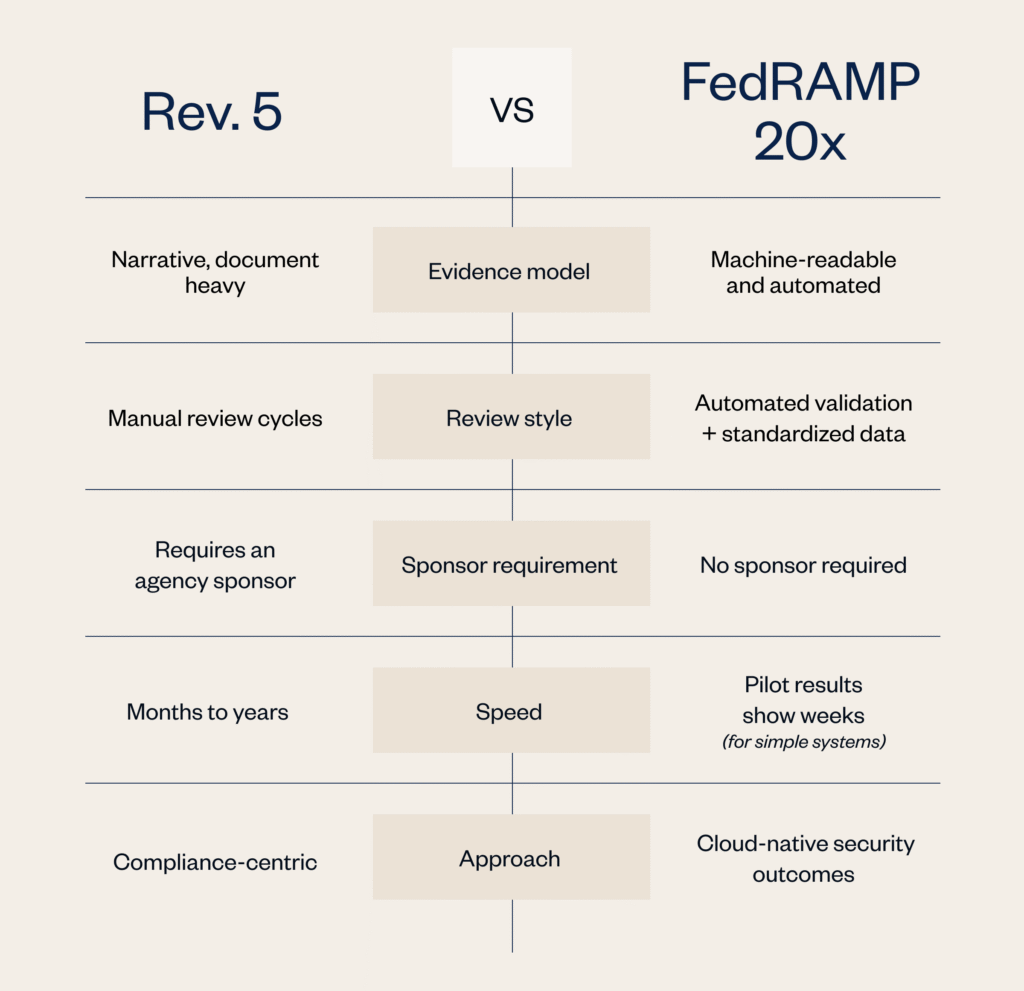
FedRAMP 20x is an initiative by the GSA to build new FedRAMP authorization paths, streamline processes through automation, and encourage government-wide adoption of commercial cloud services. Instead of the traditional document-centric process, 20x leans into machine-readable evidence and automation, which has shown significantly shorter time to authorization in the pilot compared to legacy pathways.
Not only does it reimagine the documentation process, but it flips the entire security review process on its head. Instead of reviewing via the control-by-control narrative approach, it has developed “Key Security Indicators” (KSIs), which are a set of security capabilities that focus on measurable outcomes instead of prescriptive processes.
It’s important to note that the 20x program is currently being developed, as it’s going through its pilot phases with the goal of becoming publicly available Q3 of 2026.
How the legacy FedRAMP pathway operates
The traditional FedRAMP authorization model is rooted in National Institute of Standards and Technology SP 800-53 Rev. 5 controls and emphasizes thorough documentation, manual review, and compliance reporting.
Key characteristics of the Rev. 5 pathway include:
- Extensive System Security Plan (SSP) documentation
- Manual narrative evidence review
- Agency partner or “sponsorship”
- Iterative PMO review cycles
These aspects build high assurance but often at the expense of speed and cost.
FedRAMP 20x vs Rev. 5: Key differences
FedRAMP 20x is not a “shortcut”— it’s a different pathway that prioritizes automation over narrative descriptions and manual reviewer interpretation. Here’s a quick look at how the legacy process works compared to 20x:
FedRAMP 20x phases and status
FedRAMP 20x is being delivered in phases, each with specific goals and pilots. Official documentation notes that timelines are estimated and subject to change based on real-world feedback.
Phase 1 – FedRAMP 20x Low pilot (completed)
Tested the first version of the 20x approach with Low impact authorizations, introducing machine-readable evidence and alternative validation methods.
A-LIGN participated as a 3PAO assessor of 20x Low systems as well as getting their own audit management software, A-SCEND, 20x Low Authorized.
Phase 2 – FedRAMP 20x Moderate pilot (active / current)
Participation was limited and not open to the general public; 13 selected CSPs from the Phase 1 20x Low pilot are working with FedRAMP and assessors to test the approach. That approach focuses on Moderate impact systems using automation and Key Security Indicators (KSIs).
The goals of Phase 2 are to:
- Test how CSPs can effectively meet automated validation requirements for initial and ongoing FedRAMP Authorization
- Test how these automated capabilities can be effectively assessed by third parties
- Understand how providers and assessors can work together to deliver innovative evidence of the ongoing security decisions within a cloud service
This is active and estimated to operate through Q2 of 2026.
What’s next (estimated goals)
While the published timeline from FedRAMP outlines estimated goals, they’ve also introduced a new naming convention for certification classes. The terms “Low,” “Moderate,” and “High” are being replaced with the following:
- Class A: Replaces FedRAMP Ready
- Class B: Replaces Low
- Class C: Replaces Moderate
- Class D: Replaces High
Additionally, there will now be a single certification name called FedRAMP Certified, as the “FedRAMP Validated” naming convention has been dropped.
Here’s what will come next after the current Phase 2 pilot ends:
Phase 3 – Wide-scale adoption of Class B and Class C
This is the phase in which Class B and Class C authorizations will become publicly available. Before that can happen, FedRAMP will formalize all Class B and Class C requirements based on the outcomes of Phase 1 and Phase 2.
This is estimated to happen in Q3-Q4 of 2026.
Phase 4 – Class D pilot
While the Class B and Class C authorizations continue, the pilot program for Class D authorizations will begin. This is targeted at hyperscale IaaS and PaaS providers, according to FedRAMP.
Note: During this phase, all Rev. 5 Authorized providers will be required to transition to machine-readable authorization data for both initial and continuing authorization.
This is estimated to happen in Q1-Q2 of 2027.
Phase 5 – End of life for new Rev. 5 authorizations
FedRAMP will stop accepting new Rev. 5 authorization applications on June 11, 2027. FedRAMP will also provide a clear path and timeline for ensuring all legacy Rev. 5 Authorized CSOs can transition to a 20x-based authorization. The deadlines for transitioning are not defined but are stated as “likely to include multi-year deadlines”
This phase is estimated to happen in Q3-Q4 of 2027.
Note: FedRAMP emphasizes that these timelines are goals and may shift as the program learns from pilot feedback.
What this means for cloud providers
Early planners: Understand that 20x is not fully baked, but the direction is clear and will be publicly available soon. Automation and machine-readable evidence are becoming central, even if you are planning for a Rev. 5 Authorization.
Mid-Rev. 5 authorizing CSPs: Don’t assume you can pivot lanes mid-process without analysis, but be sure to build awareness of 20x and how it may impact future offerings.
Already authorized providers: Monitor how reauthorization and continuous monitoring under 20x pilots evolve. Plan for a transition to machine-readable authorization data.
Across the board, treating 20x as “something to keep an eye on” is no longer sufficient — it should be part of your compliance roadmap for 2026 and beyond.
Strategic takeaway
FedRAMP 20x represents a generational shift in federal cloud authorization — one rooted in automation, standardization, and scalable evidence models. It’s still in pilot, but its goals are ambitious:
- Lower administrative friction
- Support faster adoption of secure cloud tech
- Enable more providers to participate in the federal market
Planning now will save tactical scramble later.